

Artificial Intelligence is rapidly becoming part of everyday business communication, but are we relying on it too heavily? In this thought leadership article, Regine le Roux, Founder and Managing Director of Reputation Matters, explores five dead giveaways that AI may have done the writing for you, and why over-reliance on AI could impact your reputation.
AI is My Bestie. But There is a Problem.
I will admit it. I use Artificial Intelligence regularly. I used to be very wary of it. Now, I jokingly and affectionately refer to ChatGPT as my “bestie.”
AI has become part of my daily workflow. It helps brainstorm ideas, structure thinking, refine wording, summarise information and save time. In many ways, it is an extraordinary tool.
But there is a growing problem.
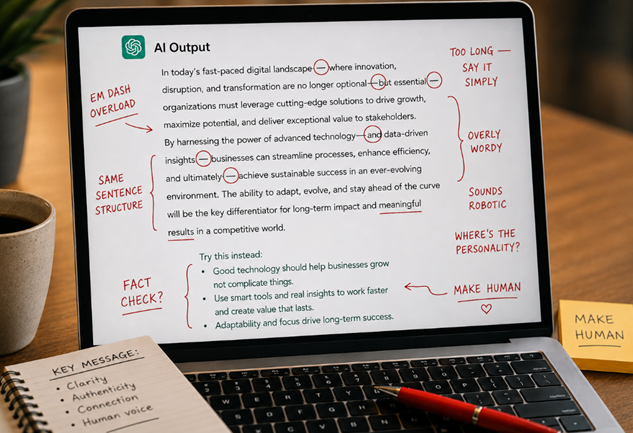
It is not AI itself. The problem is uncritical, lazy, copy-paste use without human input, refinement or ownership. People are not making the communication their own. Earlier this week, I encountered a situation where it was very clear that a candidate applying for a position had relied heavily on AI to generate answers in their application form, removing any real sense of personality, independent thinking or authenticity. All things that matter when recruiting the right person.
I also see it far too often in business correspondence where the communication feels generic, repetitive and strangely disconnected from the person behind it.
You can often spot AI-generated content almost immediately through the perfect structure, unnecessarily long explanations and neutral personality.
Here are five dead giveaways that AI did the writing, not you.
1. Em dashes
These are those long punctuation marks that suddenly started appearing everywhere. Once you notice them, you cannot unsee them.
The problem is not the punctuation itself. The problem is what it represents. Communication that feels manufactured rather than human. People may not always say “This was written by AI,” but they often feel it.
In reputation management, the human element matters more than people realise. Reputation is built through trust, consistency, authenticity and relationships. When communication starts sounding generic, overly scripted or emotionally disconnected, audiences notice.
2. Everything becomes too wordy
AI loves words. Lots of them.
Simple thoughts become long explanations filled with unnecessary context and filler. Something that could have been said in a single line becomes three paragraphs long.
In business communication, clarity builds credibility. Sometimes shorter really is smarter.
3. Your personality disappears
One of AI’s biggest risks is that it smooths out individuality. Everything starts sounding safe, neutral, polished and oddly similar.
People connect with personality. They connect with humour, honesty, quirks and human imperfection. That is what builds relationships and ultimately a solid reputation.
4. Repetition creeps in
AI often repeats the same point several times using slightly different wording. Once you notice it, you start seeing it everywhere.
In fact, trying too hard to sound professional can have the opposite effect.
5. It sounds confident, even when it is wrong
This one is particularly dangerous. AI can present inaccurate information with enormous confidence. It does not always distinguish clearly between fact, assumption and interpretation.
AI should support expertise, not replace judgement. You have to fact-check everything.
The human layer still matters
AI helped write this article, but I still had to write, think, tweak and polish. Bestie just made the process smoother.
I certainly did not accept the first draft we worked on. There were multiple iterations to make sure it still sounded like me.
It is important that you challenge it, shape it, refine it and, importantly, know when to stop editing. There comes a point where too much polishing removes personality rather than improves clarity, and it can take you down a never-ending path of micro-edits if you let it.
As much as AI is a marvellous tool, trust, relationships, emotional intelligence and judgement are what ultimately build your reputation.