

Boma Amos-Atuboyedia, Community Manager at The Comms Avenue, shares her experience managing a Pan-African community of communications professionals and some of the lessons she’s learnt along the way. In this article, she discusses what she’s learnt about effective writing and storytelling. She also introduces her personal Clarity Checklist, a helpful resource she has developed to guide her writing.
When I started my job as a Community Manager, I had no idea what it would entail. I didn’t think I would write as much as I currently do. I knew I would be writing, but I thought it would be on a much smaller scale. Then, a turn of events put me in a position where I had to write a lot more, and boy, oh boy, is writing not easy.
Before this, I mostly wrote based on my understanding of things and how I felt about a situation. This made me believe I was a fairly decent writer. I’m not saying I’m not, but what I currently write is quite different from what I was used to, and adjusting to that change was a little harder than I expected. I also depended on AI a bit too much (my bad!).

Writing for other people and social media is slightly harder than writing for yourself. When I first started writing captions for our posts, I thought it was easy. If I made mistakes, my boss would correct them, and that would be it. But as I grew in the job, she stopped correcting everything and expected me to figure things out myself.
That’s when it became a lot harder. I realised I had forgotten quite a few things I’d learned in school. I would get feedback like, “Oh, I think you’ve said this one too many times.” “Can you write this from a different angle?” “This is too long.” “This is too short.” Or, “What exactly are you trying to communicate here? The person reading this needs to understand where you’re coming from.”
Sometimes, I would get so frustrated because the back-and-forth over one caption or message could take hours and even spill over into the next day. It made me realise that writing wasn’t just about putting words together. There was a lot more thought that needed to go into it, and I was still figuring out how to get that right.
Let me not even begin to talk about what dealing with people is also like!
My time in this job has made me understand that not everyone thinks like you or understands things the way you do. This is especially important because the community I manage is quite large, with people from different parts of Africa. Cultural nuances and other differences play a big role in how I interact with people and how I write. Sometimes, knowing what you want to say doesn’t automatically mean you’ve communicated it clearly or that the other person will understand you.
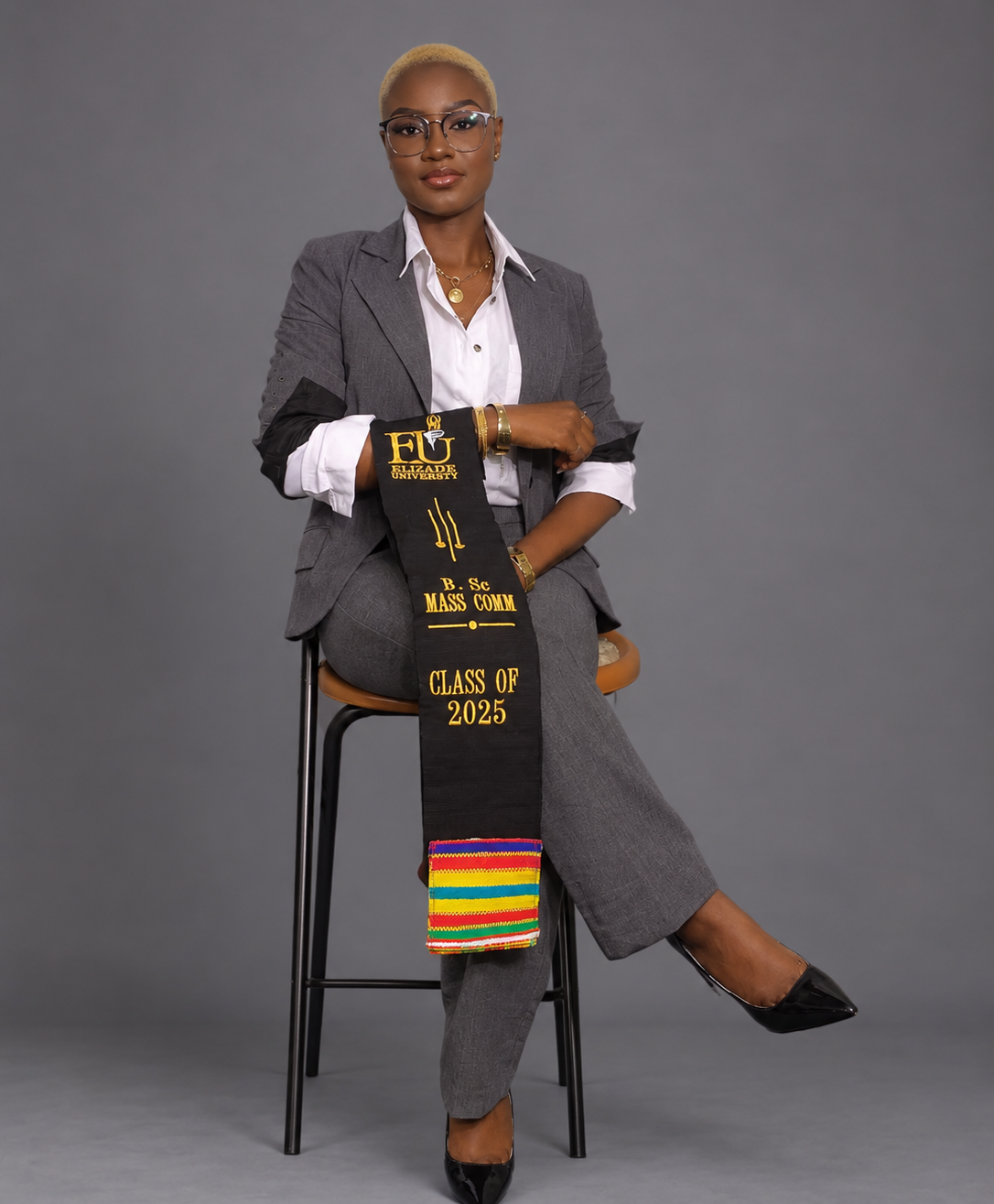
You can write what you think is a beautiful caption or message, and the very people you’re trying to reach might not understand what exactly you’re saying. You have to think about the people you’re writing for. Ask yourself: Will these people understand me? Could they interpret this message differently from how I intend it? Is this message important to them, and how can I make that clear?
Questions like these help you understand the perspective of the person who will be reading your work. People say you have to think like a thief to catch a thief. I say you have to think like your audience to communicate effectively with them. Always think about the person reading your work, even before you start writing.
However, this isn’t the only thing you should consider when writing. A couple of months ago, I read an article by a very lovely and knowledgeable woman, Damilola Orenisile, titled “The Five Cs of Communication: A Timeless Framework Every Young Professional Should Know.” It introduced me to principles I now try to follow every day when I write.
The article talks about five things we should consider when communicating. Can the audience understand the message? Have I removed unnecessary words without losing important meaning? Have I checked the facts, spelling, names, dates, and other details? Have I included specific, meaningful information instead of vague statements? Have I given the audience everything they need to understand or act on the message?
These principles have made me realise that writing requires a lot more care than I initially thought. As much as I want to pass information across, I should also be able to do so in a way that allows people to properly understand and process what I’m saying. They should be able to read what I’ve written and think, “Okay, I know what I’m expected to do after reading this,” or, “This is what I’ve gained from reading this. This is my takeaway.”
I should never leave people confused after they’ve read something I’ve written.
Remember when I said I had forgotten some of the things I was taught in school? Well, I had to go back to one of the very first things they teach Mass Communication students about writing: the 5 Ws and H.
I remember my lecturer, Dr. Tosin Adesile, telling us that we would need them in almost everything we wrote. At the time, I didn’t quite believe him. I thought he just wanted us to learn them because they were part of our coursework. Now, I realise just how much I need them.
Don’t get me wrong, I knew they were important in writing and that they could be used for more than just writing news stories. But I think I only fully appreciated their importance when I had to go back to using them in my work.
For those of you who don’t know what the 5 Ws and H are, they are fundamental questions you ask when putting together a piece of communication. They stand for Who, What, When, Where, Why, and How.
For example: Who is the event for? What is happening? When is it happening? Where is it taking place? Why should the audience care? How can people participate or get more information?
These don’t have to be the exact questions you ask every time because we all communicate for different reasons and purposes. However, you should always be able to answer the 5 Ws and H as they relate to whatever you’re working on, whether it’s an event, programme, story, press release, internal announcement, email, stakeholder communication, or anything else.
All this being said, good writing and effective communication go beyond thinking about your audience, following the Five Cs, and answering the 5 Ws and H. I promise you, I’ve done all these things and still written captions and messages that didn’t quite get the job done!
You have to think a little further. Ask yourself: Does my audience understand the purpose of this message? Am I considering their feelings, backgrounds, culture, and other things that may influence how they receive it? Am I selecting the right information? And, most importantly, does the message do what it is supposed to do?
Because if you’re writing to entertain people and you end up boring them, then you haven’t achieved your purpose. Writing is an art, and there’s something so beautiful about people reading what you’ve written, understanding it completely, and seeing the beauty in it.
It may come naturally to some people, but for those of us who aren’t necessarily blessed with the gift and have had to learn and master it, we have to understand these principles and allow them to guide our work. That way, when we write, people can appreciate what we’ve put together instead of struggling to understand what we’re trying to say.
Now, I’m going to let you in on a little something I’ve created for myself and use whenever I’m writing. It’s called the “Clarity Checklist” (still a working name!).
I find this checklist particularly helpful because there are times when I forget to consider certain things while writing. It has three themes, each with a few things to tick off. Depending on what you’re writing, you can start with any of the themes, but the idea is to go through everything that applies to your work. And if something doesn’t apply, feel free to leave it out.
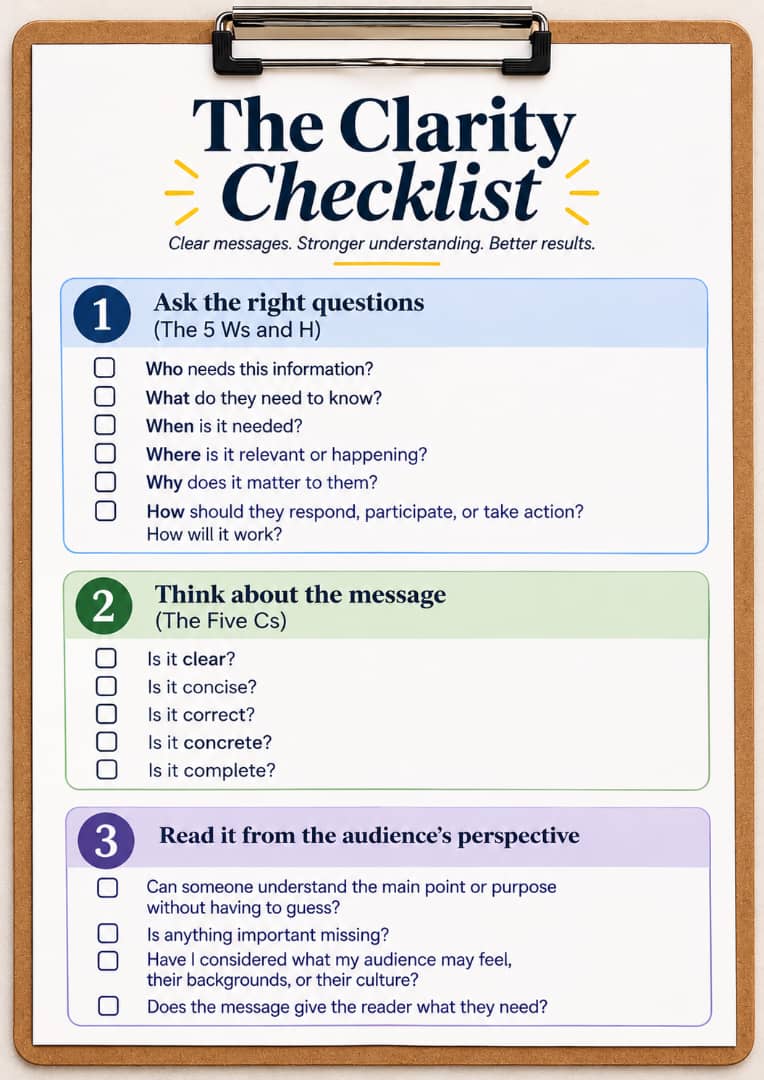
Art comes in different forms, and so does writing. There are different types of writing, but no matter what you’re working on, whether it’s captions, press releases, news stories, novels, skits, or anything else, I hope this checklist helps you think more intentionally about what you’re putting out there.
Because at the end of the day, it’s not just about finding the right words. It’s about making sure the people reading them understand what you mean. And, of course, letting them see the beauty in what you’ve written.